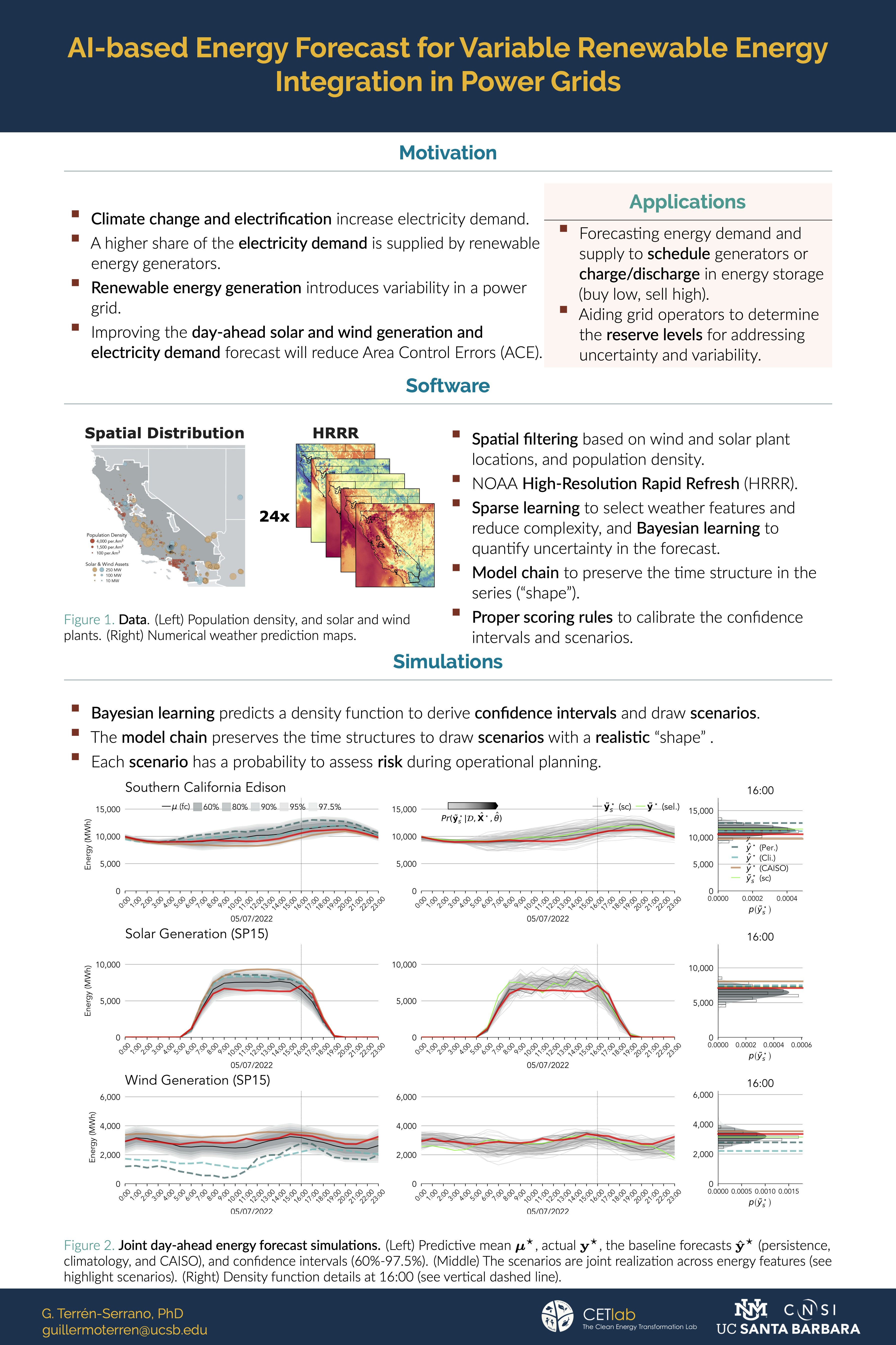
Improving probabilistic day-ahead energy forecasts by integrating numerical weather predictions with AI/ML models, and reducing the computational complexity of stochastic unit commitment and economic dispatch models through scenario selection to mitigate energy curtailment, load shedding, and price volatility. The goal is to dynamically determine operating reserve requirements by quantifying forecast uncertainty, thereby supporting ancillary service procurement and headroom allocation in unit commitment decisions.
Stochastic Unit Commitment and Economic Dispatch
We introduced a methodology that leverages statistical functional depth metrics to identify the most operationally risky scenarios—those likely to result in high generation costs, reserve shortfalls, load shedding, or renewable curtailment (Terrén-Serrano & Ludkovski, 2025). Screening probabilistic scenarios before they enter stochastic unit commitment and economic dispatch models reduces their computational burden while preserving the risk information most relevant to grid operations. This work is conducted as part of the ORFEUS team at Princeton University, within the ARPA-E PERFORM program, and was presented at the 2024 ARPA-E Energy Innovation Summit.
Probabilistic Day-Ahead Energy Forecast
We developed a fully probabilistic day-ahead joint forecast of wind and solar electricity generation and demand, published in Nature Communications(Terrén-Serrano et al., 2026). Applied to the three zones of the California Independent System Operator, the best-performing model improves forecast skill by 25% relative to current benchmarks, and forecasts based on joint probability distributions enable a more effective allocation of operating reserves than conventional deterministic approaches. The corresponding software and visualization tools are publicly available on GitHub.
This work was supported by my 2023 CNSI Climate Innovation Fellowship at the University of California, Santa Barbara. We presented it at the 2024 Macro-Energy Systems Workshop at Princeton University, the 2025 IEEE PES Grid Edge Technologies Conference & Exposition in San Diego (Terrén-Serrano et al., 2025), and the ESIG 2025 Forecasting & Markets Workshop in Nashville.
References
2026
JOURNAL
Probabilistic day-ahead forecasting of system-level renewable energy and electricity demand
Increasing shares of wind and solar generation, together with rising electricity demand, introduce growing uncertainty into power system operations. Accurate day-ahead forecasts of electricity demand and renewable generation are essential for system operators to coordinate electricity markets and maintain reliability at low cost. Here, we show that forecasting based on joint probability distributions of demand and renewable supply can substantially improve system-level forecasting performance using publicly available weather data. We develop multiple day-ahead forecasting models that combine machine learning methods to identify relevant weather variables with probabilistic approaches to quantify forecast uncertainty, and we evaluate these models using proper scoring rules. Applied to the three zones of the California Independent System Operator, the best-performing model improves forecast skill by 25% relative to current benchmarks. We further show that forecasts based on joint probability distributions enable a more effective allocation of operating reserves than conventional deterministic approaches, highlighting the potential of probabilistic machine learning to enhance market efficiency and grid stability in increasingly decarbonized power systems.
@article{terren2026probabilistic,title={Probabilistic day-ahead forecasting of system-level renewable energy and electricity demand},author={Terr{\'e}n-Serrano, Guillermo and Deshmukh, Ranjit and Martínez-Ramón, Manel},journal={Nature Communications},year={2026},doi={https://doi.org/10.1038/s41467-026-69015-w},publisher={Nature Publishing Group UK London}}
2025
JOURNAL
Extreme day-ahead renewables scenario selection in power grid operations
We propose and analyze the application of statistical functional depth metrics for the selection of extreme scenarios for realized electric load, as well as solar and wind generation in day-ahead grid planning. Our primary motivation is screening probabilistic scenarios to identify those most relevant for operational risk mitigation. To handle the high-dimensionality of the scenarios across asset classes and intra-day periods, we employ functional measures of depth to sub-select outlying scenarios that are most likely to be the riskiest for the grid operation. We investigate a range of functional depth measures, as well as a range of operational risks, including load shedding, operational costs, reserve shortfalls, and variable renewable energy curtailment. The effectiveness of the proposed screening approach is demonstrated through a case study on the realistic Texas-7k grid.
@article{TERRENSERRANO2025125747,title={Extreme day-ahead renewables scenario selection in power grid operations},journal={Applied Energy},volume={391},pages={125747},year={2025},issn={0306-2619},doi={https://doi.org/10.1016/j.apenergy.2025.125747},author={Terrén-Serrano, Guillermo and Ludkovski, Michael},keywords={Functional depth, Operational planning, Power grids, Renewable energy, Statistical extremality},}
PROCEEDINGS
Day-Ahead Operational Forecast of Aggregated Solar Generation Assimilating Mesoscale Meteorology Information
System-level (balancing area) forecasting errors can increase with growing shares of solar generation, thus increasing scheduling changes, area control errors, and system frequency variation. This investigation introduces a method to combine a spatial numerical weather forecast with solar generation time series to improve the performance of aggregated system-level day-ahead solar forecasts. The proposed method utilizes sparse learning to select spatial weather features (long-wave, short-wave, and clear-sky radiation) and Bayesian learning to predict the mean and variance in the forecast. The proposed method is probabilistic and preserves time structure in the predictive distribution. Different combinations of four sparse learning and three Bayesian learning methods are evaluated with four proper multivariate scoring rules to select the best model. Applying this method to the California Independent System Operator (CAISO) grid, the daily forecast improved by up to 10.4% relative to their forecast.
@inproceedings{TERRENSERRANO2025,author={Terrén-Serrano, Guillermo and Deshmukh, Ranjit and Martínez-Ramón, Manel},booktitle={2025 IEEE PES Grid Edge Technologies Conference & Exposition (Grid Edge)},title={Day-Ahead Operational Forecast of Aggregated Solar Generation Assimilating Mesoscale Meteorology Information},year={2025},volume={},number={},pages={1-5},keywords={Uncertainty;Time series analysis;Predictive models;Probabilistic logic;Bayes methods;Numerical models;Solar power generation;Reliability;Wind forecasting;Meteorology;Sparse Learning;Bayesian Learning;Solar Forecast;Mesoscale Meteorology},doi={10.1109/GridEdge61154.2025.10887459},issn={},month=jan,}